
NEWS
BusinessCoca-Cola HBC Invests $34 Million in Digitised Egypt Operation to Cover Europe, Africa
By Emmanuel Oluwafemi Oniyide | 8th Jul 2026 | 9:12 AM
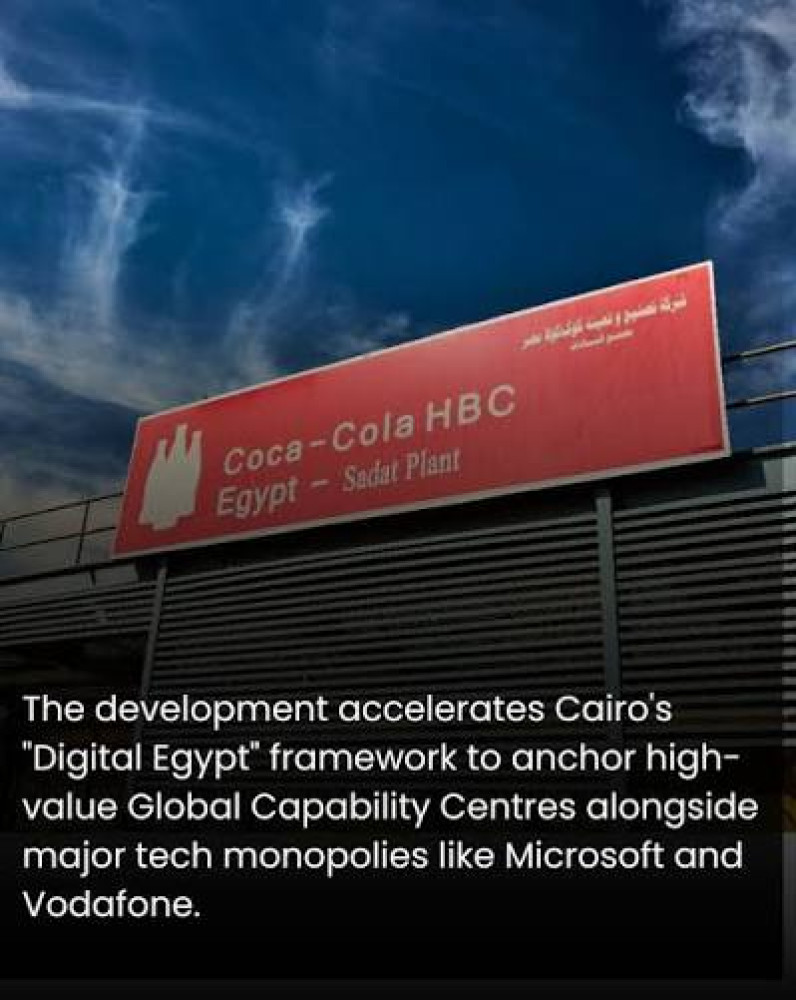

Coca-Cola HBC has chosen Egypt to host its newest global software engineering centre, reinforcing the country's growing reputation as one of Africa's emerging destinations for high-value technology investment rather than traditional outsourcing.
The Swiss-headquartered bottling partner of The Coca-Cola Company has opened a Digital Hub in Cairo that will develop and operate business-critical technology platforms supporting its operations across 27 markets in Europe and Africa.
The centre currently employs about 250 engineers, software developers and digital specialists and is expected to expand to 450 employees by 2027.
Egypt's Information Technology Industry Development Agency (ITIDA) estimates the facility will generate approximately $34 million in annual digital export revenues once fully operational.
Unlike conventional outsourcing centres that primarily handle customer support or back-office functions, Coca-Cola HBC's Cairo operation has been designed as a global engineering centre responsible for building products, developing artificial intelligence solutions and managing digital platforms used across the company's international business.
The hub will lead software engineering within Coca-Cola HBC's international technology organisation, joining existing digital centres in Sofia and Athens. Together, the network comprises more than 500 technology professionals responsible for over 130 software products supporting the company's operations across Europe and Africa.
Among its first projects is an AI-powered application that enables field sales representatives to personalise promotions in real time based on customer needs, alongside upgrades to the company's digital customer platform.
The investment marks another milestone in Coca-Cola HBC's expansion in Egypt following its 2022 acquisition of The Coca-Cola Bottling Company of Egypt. More recently, the company announced plans to invest about $1.28 billion in Egypt by 2030, underscoring its long-term commitment to one of Africa's largest consumer markets.
The project reflects the country's broader ambition to become a regional hub for global capability centres (GCCs), high-value operations where multinational companies centralise software engineering, artificial intelligence, cybersecurity, cloud computing, product development and other specialised digital functions.
Over the past four years, Cairo has become increasingly attractive to multinational corporations seeking alternatives to traditional technology hubs in Eastern Europe and Asia. Egypt offers a combination of competitive operating costs, a large pipeline of multilingual engineering graduates, proximity to European markets and a time zone that allows companies to support operations across Europe, the Middle East and Africa.
Under its Digital Egypt strategy, launched in 2022, the government has prioritised digital exports as a new source of foreign exchange alongside tourism, manufacturing and the Suez Canal. ITIDA says agreements signed with 55 multinational and local companies in 2025 are expected to create more than 75,000 jobs over three years, with Coca-Cola HBC among the participating investors.
The strategy is already attracting global technology firms. Egypt hosts capability centres operated by companies including Microsoft, VOIS by Vodafone, Atos, Teleperformance, Concentrix and Majorel, while international businesses continue to expand engineering, cybersecurity, finance and digital support operations in the country.
The competition is not limited to Egypt. Across Africa, governments are increasingly competing for high-value digital investment as companies rethink where they locate technology talent. South Africa has traditionally led in business services, Morocco has emerged as a major francophone outsourcing destination, while Kenya and Rwanda are positioning themselves as centres for software development and digital innovation.
Instead of competing solely on labour costs, African countries are increasingly seeking to attract engineering and research functions that generate higher wages, stronger technology transfer and greater export earnings.
For Coca-Cola HBC, selecting Cairo to build software and AI capabilities rather than another customer support centre signals confidence in Egypt's engineering talent and digital ecosystem. The country is no longer competing simply to host outsourced business services. It is increasingly positioning itself to build the software, artificial intelligence and digital products that multinational companies use to run their global operations, a transition that could reshape the country's export profile and strengthen its role in Africa's growing digital economy.
The investment signals a broader shift in multinational strategy. Rather than using Africa mainly for manufacturing or customer support, companies are increasingly locating software engineering, AI and digital product development on the continent.





Comment on this Post
Comments (0)