
NEWS
PoliticsRavi Jaipuria Stakes $32 Million in East African 52-acre beverage Plant
By Emmanuel Oluwafemi Oniyide | 9th Jul 2026 | 9:15 AM
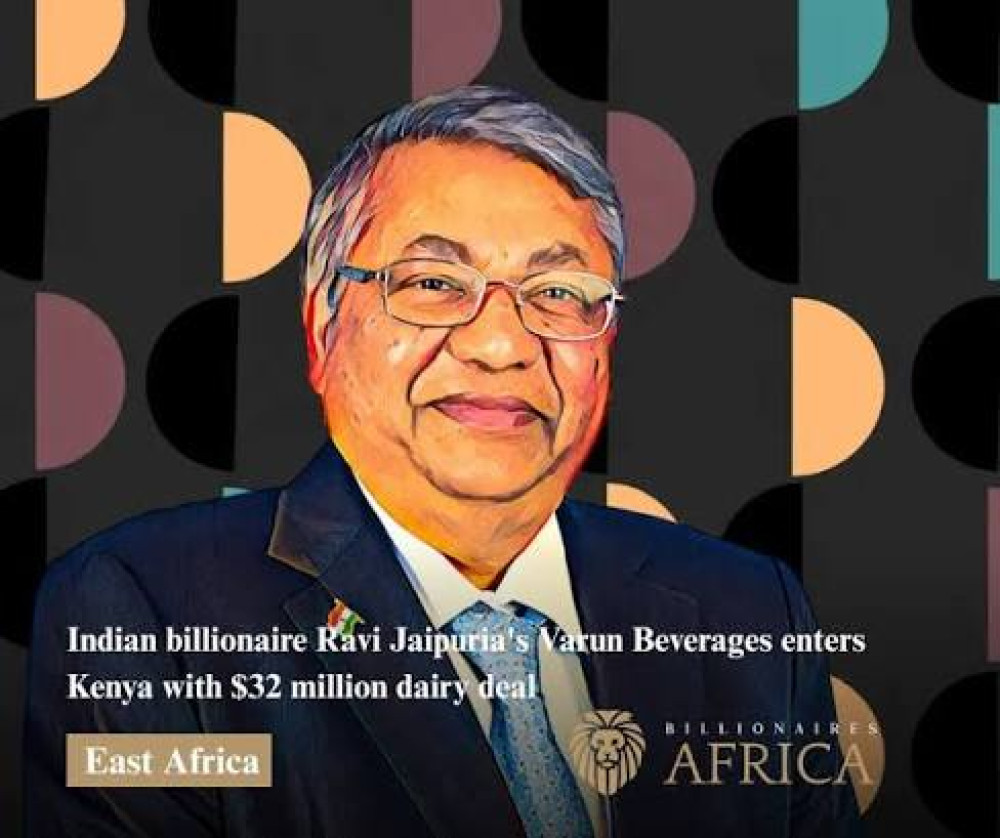

Kenya, East Africa's largest economy, is witnessing a wave of billionaire-backed investments as some of the continent's and Asia's richest businessmen move to capture its fast-growing consumer and industrial markets.
BL Industries Kenya, a wholly owned subsidiary of Varun Beverages, has signed an agreement to acquire the dairy beverages, juices and packaged drinking water business of Devyani Food Industries Kenya in a transaction expected to close by August 1, 2026.
Once completed, the deal will give Varun Beverages control of a 52-acre manufacturing site in Nakuru, Kenya's fourth-largest urban centre, with 17,500 square metres of built-up area, key food safety certifications, advanced water purification systems and modern manufacturing machinery.
The $32 million investment in the beverage plant will place Ravi Jaipuria, widely known as India's "Cola King" and valued by Forbes at $12 billion, alongside Nigerian billionaire Aliko Dangote and Tanzanian billionaire Mohammed Dewji, who have also been expanding their investments in Kenya's industrial and consumer markets.
More broadly, the Kenya acquisition comes shortly after Varun Beverages extended its bottling agreement with PepsiCo, strengthening a partnership that has powered Jaipuria's rise from a single plant into one of India's biggest consumer goods empires.
The revised agreement extends Varun Beverages' PepsiCo bottling licence in India to April 30, 2049, from the previous expiry date of April 30, 2039.
Notably, the May 21 agreement also removes restrictions that had stopped Varun Beverages, PepsiCo's largest franchise bottler outside the United States, from pursuing non-PepsiCo business activities while handling brands such as Pepsi, Mountain Dew, Mirinda, 7UP, Tropicana, Slice, Aquafina, Sting, Gatorade and Lipton Ice Tea.
Meanwhile, Kenya's drinks market is becoming more competitive as global bottlers and regional challengers move to win price-sensitive consumers in a segment still dominated by Coca-Cola.
MeTL Group, owned by Tanzanian billionaire Mohammed "Mo" Dewji, is building a $50 million soft drinks plant in Mombasa to produce Mo Cola, Mo Xtra and Mo Malto, with plans to sell Mo Cola at a fraction of Coca-Cola's retail price.
Against this backdrop, PepsiCo would gain a second independent production base in Kenya once Varun Beverages begins manufacturing carbonated soft drinks at the Nakuru facility. PepsiCo brands are already produced in the country by SBC Kenya, a separate bottler owned by Uganda's Crown Beverages, which has operated a plant in Ruaraka, Nairobi, since 2013.
Beyond beverages, Nigerian billionaire Aliko Dangote is approaching Kenya from a larger industrial angle, with plans to finance a proposed 700,000-barrel-per-day refinery in Lamu through internal cash, bonds and an initial public offering.
Together, these investments are reinforcing Kenya's position as one of Africa's most attractive industrial and consumer markets, even as the country still trails larger investment destinations such as South Africa and Morocco.
For Varun Beverages, Kenya offers a smaller and cleaner route into East Africa after a failed attempt to buy larger PepsiCo bottling assets in Tanzania and Ghana for $169.6 million. Those deals failed to close by their March 2025 long-stop dates after conditions were not met, while the Tanzania agreement later drew regulatory and tax complications. The Kenya deal avoids some of that complexity because Devyani Food Industries Kenya is part of the same promoter group controlled by the Jaipuria family, which also controls Varun Beverages.
Even so, Varun Beverages has continued to build scale across Africa through acquisitions, new plants and distribution agreements. In December 2023, it acquired PepsiCo's South African bottler Bevco for $158 million, giving it franchise rights in South Africa, Lesotho and Eswatini, as well as distribution access in Botswana and Namibia. Thereafter, it acquired South African soft drinks maker Twizza, further strengthening its position in one of Africa's largest beverage markets. At the same time, the company has been expanding in Central Africa, where it is developing a $50 million bottling plant in Kinshasa and another facility in Lubumbashi in the Democratic Republic of Congo.


Comment on this Post
Comments (0)