
NEWS
PoliticsPetrol: How Smugglers Exploit Crossborder Marriages
By Emmanuel Oluwafemi Oniyide | 28th Sep 2026 | 10:23 AM
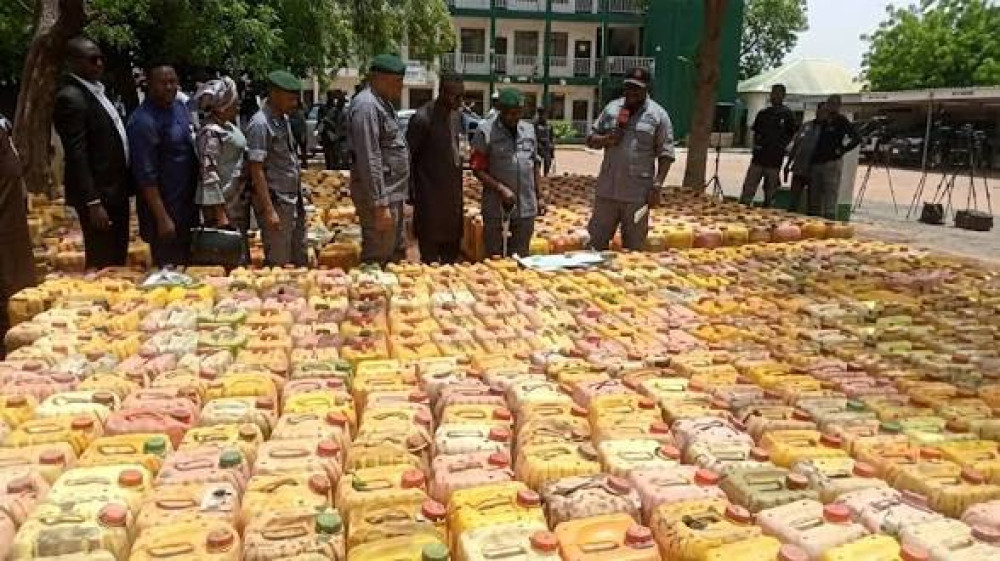

The Nigeria Customs Service (NCS) has revealed that some petrol smugglers deliberately marry two wives from both sides of the Nigerian-Benin Republic border to disguise their illicit trade as domestic fuel use, as authorities struggle to curb a booming cross-border smuggling economy.
The disclosure was made by Deputy Superintendent of Customs Chado Zakari, spokesman of the Idiroko Customs Command, in an interview with the Nigerian Tribune published at the weekend.
According to Zakari, smugglers exploit the porous nature of the border and the legal allowance for moving small quantities of petroleum products for domestic use.
“From our investigation, these smugglers have two wives. One wife will be in Idiroko in Nigeria, while the second wife will be in Igollo, in Republic of Benin,” Zakari said. “The husband will now be shuttling between both houses with these petroleum products, claiming it’s for domestic use. You know the movement of small quantity of petroleum products is not a crime if it’s not for commercial purposes. How do you now combat such smuggling?”
Zakari explained that the porosity of the Nigerian-Benin border is compounded by communities where houses straddle both countries. “There are some communities where we have houses located in between both countries,” he said. “In such communities, the living room of the house will be in Nigeria, while the bedroom of the same house will be in Benin Republic.
Tell me, how do you stop smuggling from taking place in such an environment?”
The Service can only suppress smuggling, Zakari added, expressing doubt that it can be eradicated. He said the Command has established relationships with traditional rulers in border communities and organised sports competitions in a bid to discourage residents from the trade.
Superintendent of Customs Tunde Ayagbalo, spokesman of the Seme Customs Command, identified bad road networks as a major operational challenge. “The routes the smugglers take can be unmotorable,” Ayagbalo said. “The smugglers navigate these bad roads with motorcycles. 100 motorcycles can move at different times with these products. Aside from using bad routes to cross smuggled petroleum products, they also carry the products through the creeks at night.” He said Customs is beginning to look at deploying drones to maintain permanent oversight of international borders, both land and waterways.
Ayagbalo also noted that border communities depend on smuggling for survival. “These border communities’ residents will tell you they don’t have industries or companies situated within their communities, so they have no other job than to smuggle petrol and other products,” he said.
The marriage strategy is not limited to the Benin border. A 2018 Daily Trust report on the Illela border in Sokoto State, which links Nigeria with the Niger Republic, quoted a community member explaining how family ties impede enforcement. “The inter-marriage is also a factor because you don’t expect me to report any smuggling activity involving my In-law who is from Niger Republic or my wife, mother or father’s relatives who are into the business,” the source said.
The Economics of Smuggling
Petrol smuggling persists because Nigerian fuel remains significantly cheaper than in neighbouring countries, even after the removal of the subsidy. The Customs Comptroller-General, Adewale Adeniyi, said in April 2025 that smuggling remains a profitable business due to price differentials across borders. According to industry data, smugglers can make an extra ₦3.5 million to ₦5.3 million in profit for every 10,000 litres diverted across the border, depending on the destination.
The Bottom Line: The use of cross-border marriages is the latest illustration of how deeply smuggling is woven into the social and economic fabric of Nigeria’s border communities. While the Customs Service continues to record seizures — including 20,500 litres of Premium Motor Spirit intercepted in July 2026 — officials acknowledge that the trade cannot be eradicated through enforcement alone, as long as the economic incentives and community ties that sustain it remain in place.





Comment on this Post
Comments (0)