
NEWS
PoliticsThree States Account for Nearly Two-thirds of Lassa fever Fatalities as 2026 Toll Hits 237
By Emmanuel Oluwafemi Oniyide | 13th Aug 2026 | 10:23 AM
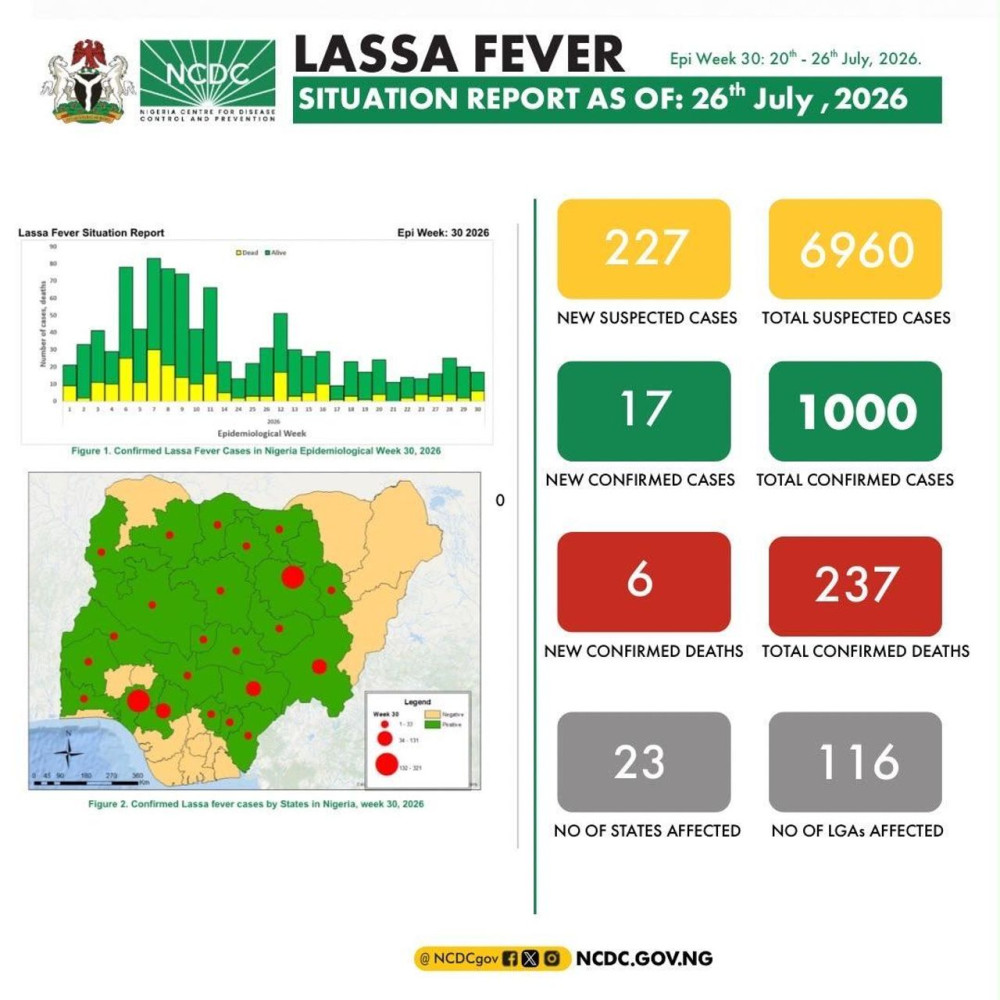

Nigeria has recorded 237 deaths from Lassa fever across 1,000 confirmed cases in the first 30 epidemiological weeks of 2026, according to the Nigeria Centre for Disease Control and Prevention's latest situation report covering July 20–26.
The case fatality rate now stands at 23.7%, up sharply from 18.8% during the same period last year.
The outbreak has spread to 23 states and 116 Local Government Areas. But the numbers tell a story of extreme concentration: Ondo, Taraba and Bauchi alone account for 151 of the 237 deaths — 63.7% of all fatalities.
Ondo leads with 73 deaths, followed by Taraba with 43 and Bauchi with 35.
Five states — Ondo, Bauchi, Taraba, Edo and Benue — account for 86% of all confirmed cases nationwide. Ondo alone represents 32% of confirmed cases, Bauchi 25%, Taraba 13%, Edo 10% and Benue 6%.
The NCDC identified late presentation of patients as a major factor driving the high death toll. "Healthcare workers should maintain high suspicion for Lassa fever and initiate timely referral and treatment, and adhere to standard infection prevention and control procedures," the agency said in its report.
During epidemiological week 30, Nigeria recorded 17 new confirmed cases — a slight decline from 20 cases the previous week. The new cases were reported in Ondo, Bauchi, Edo and Benue states. Six deaths were recorded during the same week.
Young adults remain the most affected group. The predominant age range is 21 to 30 years, though confirmed cases span from one to 93 years, with a median age of 30. The male-to-female ratio among confirmed cases is 1:0.9.
One healthcare worker was infected during the reporting week, bringing renewed attention to the occupational risks frontline medical personnel face. The NCDC has developed a 30-day Healthcare Worker Protection Plan and deployed rapid response teams to seven high-burden states.
By week 30 of 2025, Nigeria had recorded 825 confirmed cases and 155 deaths across 21 states. This year's suspected cases have also risen to 6,960, compared with 6,731 during the corresponding period last year.
The NCDC identified poor health-seeking behaviour linked to treatment costs, inadequate awareness in high-burden communities and poor environmental sanitation as additional challenges hampering containment efforts.





Comment on this Post
Comments (0)